
Write Like Your Sanity Depends on It (Because It Might)
Four writing survival tips just for you (and me)

Today.
Oof.
Reality felt like a badly edited dystopian novel—too on-the-nose, too absurd, and somehow both too slow and too fast simultaneously. I kept checking social media. I was doomscrolling until my brain hummed like an overheating laptop.
Enter writing—not simply as my employment (which I’m incredibly grateful for today as a good friend was fired from her accounting job at the IRS), but as a coping mechanism. A lifeline. A way to process the mess, exhale the tension, and maybe turn chaos into something useful.
As Anne Lamott puts it:
"Writing has so much to give, so much to teach, so many surprises. The thing you had to force yourself to do—the actual act of writing—turns out to be the best part. It's like discovering that while you thought you needed the tea ceremony for the caffeine, what you really needed was the tea ceremony. The active writing turns out to be its own reward."
Writing as a survival skill
Sometimes, writing can be a storm drain. Without it, the downpour of my thoughts, fears, and frustrations gets dammed up, pooling, stagnating, and flooding.
Letting words flow onto the page, into a notes app, or scribbled on junk mail is a release valve for my brain.
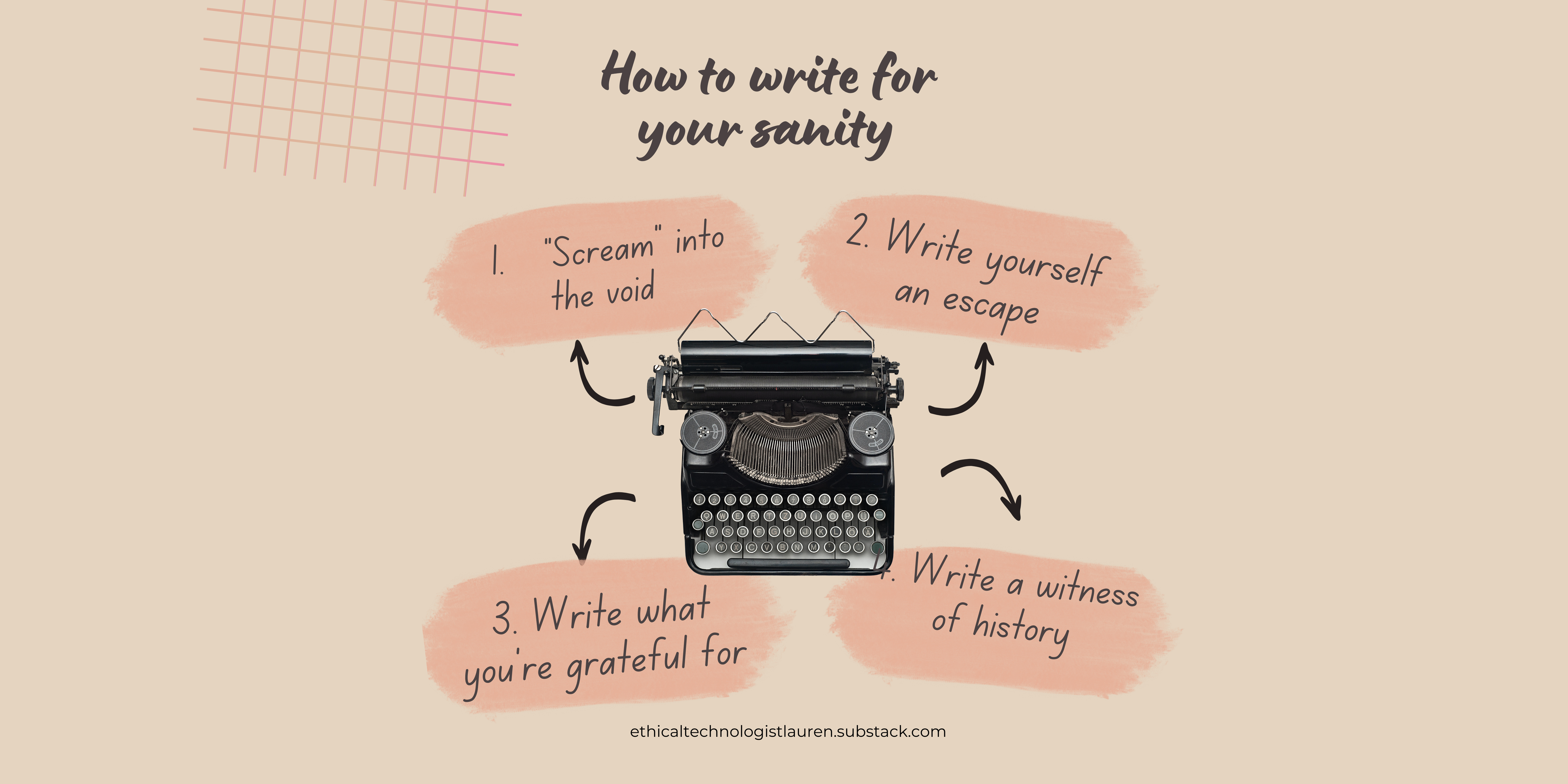
So, if you want to try it out, here are four ways you can join me and write through the chaos:
1. The rant: A safe space to scream into the void
Sometimes, you need to unload. You can employ some freewriting. This is when you write without editing, without worrying about coherence or niceties, and go until the timer stops. Let your grievances spill out. Use words you wouldn’t say in polite company. Rage about everything from broken institutions to your coffee being cold before you take a sip.
No one has to read it.
You might not even want to reread it.
But getting it out is the point.
2. The escape hatch: Write yourself somewhere else
Maybe today isn’t the day I’ll stare reality in the face. It is a Monday, after all. That’s okay.
Instead, try writing a doorway to somewhere better.
A poem about the way the light hits your kitchen counter.
A short story where you live somewhere new and tropical.
A list of words that feel good to say aloud (effervescent, petrichor, marzipan).
Let words carry you somewhere softer, slower, with fewer headlines and more poetry.
3. The gratitude list: An antidote to the noise
Gratitude isn’t about toxic positivity—it’s about recalibrating your brain so that the good doesn’t get swallowed by the bad.
Each day, write three things you’re grateful for. Nothing profound is necessary. Some days, it might just be:
Figo’s soft fur.
That friend who sent me the hilarious meme.
Listening to the piano music that found me out in the car while I waited for my daughter’s lesson.
This simple habit rewires your brain. You’ll be better at noticing small joys amid the noise.
4. The witness journal: Because this is history
When feeling overwhelmed by current events, consider documenting them. Write what it feels like to live through what’s happening in the world. Historians rely on letters and diaries from ordinary people to understand past generations.
Future generations might rely on yours. But not if it isn’t written.
What are you noticing?
What details feel surreal?
What moments of unexpected humanity have stood out?
There is power in bearing witness. Even if no one ever reads your words, the act of writing grounds you in time and reminds you that you are here, living, experiencing, and enduring.
The tea ceremony of writing
You might think you need to write for a purpose—to create something brilliant, to be productive, to make it worth the time. But as Anne Lamott reminds us, the act itself is the reward.
Like a tea ceremony, writing is a ritual. A way to steady your hands. A way to pause and process. Maybe even a way to find small beauty in the act of simply being here.
So, pick up a pen, open a blank document, or grab that half-used notebook from a few years ago. Write like your sanity depends on it.
Because honestly? It might.