
The Rhumb Line vs. Hustle Culture
Nobody tolerates uncertainty anymore.

I did it. I finally went on a decent hike again.
It’d been months, which feels medically offensive considering I live in Utah, where every third person owns a hydration backpack and talks about elevation gain like they’re training for a Sherpa apprenticeship.
Unfortunately, getting a cough in my 46th year of life triggers a full systems failure. The symptoms included coughing, poor sleep, coughing, two urgent care visits, coughing, two rounds of steroids, coughing, and an intercostal muscle strain, which is a very fancy medical term meaning “it hurts to exist near oxygen.”
That last one was especially rude because it eliminated several important activities from my life, including:
body combat classes at the gym
regulating my nervous system while parenting
walking around my neighborhood, because hills
meditation
reading the news without becoming spiritually winded
and hiking
So on Saturday, when I finally met up with Karen for a hike again, it felt less like recreation and more like a controlled re-entry into society.
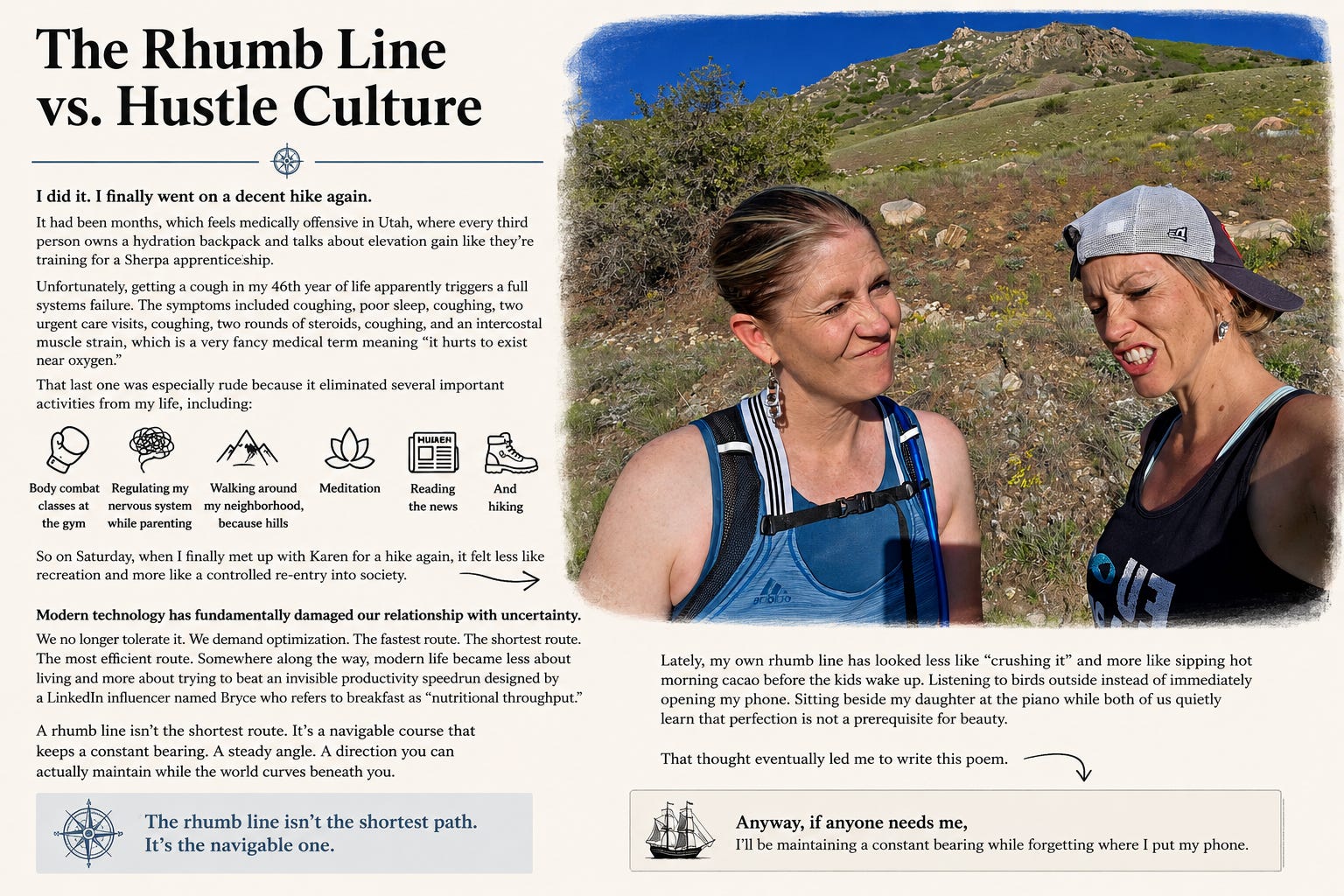
As usual, she sent me a pin.
I dropped it into Google Maps and sent back my ETA because this is now how modern adults coordinate movement. We no longer “head generally toward Farmington.” We monitor each other like refrigerated vaccine shipments.
And for reasons known only to the algorithmic gods, Google Maps never routed me over to I-15. Instead, it sent me weaving through neighborhood roads along the bench, as though I were fleeing federal authorities or trying to avoid a velociraptor migration.
Naturally, I assumed there’s gotta be a catastrophic freeway pileup. Maybe a semi had overturned. Maybe society had collapsed. Maybe someone in Utah County tried zipper merging correctly, and the entire Wasatch Front entered a state of emergency.
But no.
The freeway looked completely fine from my route on the bench.
Google simply preferred… vibes.
Since the all-knowing app told me it was the fastest route, I obeyed without question, like a medieval peasant consulting an enchanted parchment.
Modern technology has fundamentally damaged our relationship with uncertainty.
When I started driving in high school, navigation was based almost entirely on faith, vague landmarks, and whether your friend remembered to mention the ShopKo before or after the turn. You drove toward an address in a general spirit of optimism and hoped for the best. A wrong turn wasn’t a moral failing. It was part of the trip.
In college, I kept actual road maps in my car. Not metaphorical maps. Paper ones. The kind you unfolded once and then spent the rest of your natural life trying to fold back into their original shape while sweating beside a gas pump in Wyoming.
Today, if Google Maps increases the ETA by four minutes, grown adults experience all five stages of grief before the next stoplight.
We no longer tolerate uncertainty. We demand optimization. The fastest route. The shortest route. The most efficient route. Somewhere along the way, modern life became less about living and more about trying to beat an invisible productivity speedrun designed by a LinkedIn influencer named Bryce who refers to breakfast as “nutritional throughput.”
This mentality infects everything.
We’re told to optimize our workouts, our sleep cycles, our protein intake, our calendars, our children’s extracurricular activities, and eventually our personalities. Every hobby becomes a side hustle. Every quiet moment becomes “an opportunity for growth.” Every human experience is expected to justify itself with measurable output, preferably displayed in a dashboard.
Even rest requires performance metrics.
I would like to formally blame smart watches for this. Mine just told me I need to move. It’s ten to the hour.
Somewhere in Silicon Valley, a man is currently waking at 4:15 a.m., lowering himself into freezing water, drinking mushroom powder blended with collagen peptides, tracking his REM cycles, and posting online about “high-agency living,” while I’m trying to remember why I walked into the kitchen.
Which is why I’ve been thinking about rhumb lines. I’ve had thoughts on this for months.
A rhumb line isn’t the shortest route. It isn’t even the most efficient one. It’s simply a navigable course that keeps a constant bearing. A steady angle. A direction you can actually maintain while the world curves beneath you.
There’s something deeply comforting about that.
Because my life never feels like clean optimization. It feels curved. Emotional. Weathered. Human.
Lately, my own rhumb line has looked less like “crushing it” and more like sipping hot morning cacao. Listening to birds outside and trying to ignore my phone. Sitting beside my daughter at the piano while both of us quietly learn that perfection is not a prerequisite for beauty.
And yes, ironically, this reflection arrives during a season of my life where my work has become heavily focused on AI productivity tools. My productivity genuinely has increased. MCP servers and custom GPTs are astonishingly useful writing assistants. Entire workflows that once took hours now take minutes.
According to modern hustle culture, this means I am absolutely crushing it.
And yet.
The rhumb line isn’t the shortest path.
It’s the navigable one.
That thought eventually led me to write this poem.
Rhumb Line
I’ve ached awake these recent mornings
before the sun sneaks in the window,
Figo still curled like a comma in the sentence
I keep trying to finish,
and I think about direction.
Not the Dolby sound system movie theatre kind,
where a booming narrator announces
“And now she will stride into her destiny,”
but the whispering variety.
The kind you only tune into
when you’ve been holding the same bearing
long enough for it to start feeling like intention.
A rhumb line, I’ve learned,
isn’t the shortest way anywhere.
It’s just the way I can actually steer.
A constant angle. A constant hope.
A straight slant across the Mercator map,
even though the earth beneath me
is round
and complicated
and insists on curving away.
This year has curved away:
sitting at the piano with my daughter
and we both try to grasp that it doesn’t come with a perfection prerequisite,
comforting my son when change
shows up feeling like anger,
and soothing my own soul by writing essays about
faith
and algorithms.
But some days are meant for quietly navigating
the skipping beats of my own heart,
learning its geography,
how it curves away,
with its weather fronts and lenticular clouds
and long stretches of mountain slopes on the leeward side.
Somehow I found, I could choose a direction
without fastening myself
to a promised, far-off point.
I could say I’ll go this way for now,
and let the line be good enough —
the angle between me and the horizon
steady, if not heroic;
intentional, if not inevitable.
Maybe that’s the secret the sailors knew:
that life is less about arriving
and more about what it feels like
to stand on deck,
the wind whipping.
Figo sleeping on the couch,
my daughter thumping a single stubborn chord
on the slightly off-tune upright grand,
and I keep moving,
crossing each meridian
with a kind of quiet companionship.
I’m not chasing the end of anything.
I’m following a direction
with a constant bearing
while my world curves away.
The Ethical Technologist Weighs In
Technology is very good at helping us move faster. It is considerably less skilled at helping us decide where we’re actually trying to go.
Optimization isn’t wisdom. Efficiency isn’t meaning. And productivity, despite what LinkedIn is preaching to me, isn’t the same thing as living a good life.
The danger of hustle culture isn’t merely exhaustion. It’s forgetting that we aren’t machines designed for constant throughput. We’re strange, emotional creatures who occasionally lose our phones while holding them.
The rhumb line reminds me that life doesn’t require perfect certainty, flawless execution, or algorithmic optimization. It’s enough to keep a steady bearing while the world curves beneath us.
Anyway, if anyone needs me, I’ll be maintaining a constant bearing while forgetting where I put my phone.
Rhumb lines are what gave us the Mercator Projection and for that reason, I'm opposed. (Rhumb lines are straight on the Mercator Projection. Shortest paths (great circles that planes like to fly on) are curved. But on a globe, rhumb lines are spirals, while great circles are as "straight" as anything can be on a spherical(ish) surface.) This has no bearing to your point, of course.
I love this! I’m married to an engineer. He can’t help but problem solve and optimize everything, and his favorite tools to use are tech based. It’s just how he’s wired, and he has done amazing things in our household and his career with those abilities. I, on the other hand, am a slow-adopting Luddite. I rarely optimize anything and will cling to old ways as long as I can. I think we balance each other out a little with those opposite mentalities, and we find our own family rhumb line (new vocab, thanks!).
Your piece made me reflect on how much of our modern world is built by people like unto my husband. It has given us incredible convenience and ability, but maybe we need a little balancing out with the older ways of doing things sometimes too because we are barreling into some great unknowns with tech and my Luddite spidey senses are tingling!