Resistance, Ritual, and the Quiet Work of Hope
The Ethical Technologist series: Faith, Power, and Political Myth, Post 4

🪑 Language, Labels, and the Architecture of Belongin

g
A friend recently shared an Instagram Reel by @sararosecaplan where she playfully challenged viewers with a simple question: “Chair or not a chair?” She showed image after image—four legs, a stool, one with an exercise ball in it, a massive piece of furniture—and people were left debating which objects counted as a “chair.” Then, she hit the punchline: none of them were real because they were all pictures, right? (One specifically was an AI-generated image, so did that make it not a chair?)
What did this say about language?
Language is a proxy for connection, an imperfect attempt “at telepathy,” as she said it.
It got me thinking about the language games I’ve grown up with and the way we name and frame our world. In my Latter-day Saint community, we might call each other Brother or Sister so-and-so. When someone is released from a calling, like Bishop, some folks keep using the title long after, as if it’s fused into their identity. Others drop it. I call my neighbor Mike, not Bishop Sorensen, because he’s the guy who waves at us on his bike ride, not a priest in a robe. Does that make me a bad church member? (But the priesthood office…) Or just someone who prefers names over titles? It’s not a sign of disrespect, but a reflection of our personal rapport that transcends formal titles.
Names are personal. Names are connection. And the way we use language tells a story about what we value. My friend Dee changed their name. What does it say if I still call them by their old name? That I’m right and they’re wrong? That I won’t let go of a label that was never mine to hold?
It’s easy to dismiss these as surface-level things. As just words, just labels, or just preferences. But they’re not. Language is the architecture of our belonging. It’s how we map out who counts and who doesn’t. And when we deadname, erase, or diminish someone, we’re not just playing a game of semantics. We’re eroding the shared foundation that lets us live in community.
Language is the architecture of our belonging.
🕯️ The pagan ethos vs. the quiet virtues
In David Brooks’s NYTimes essay, he described the “pagan ethos” like this:
The pagan ethos has always appealed to grandiose male narcissists because it gives them permission to grab whatever they want. This ethos encourages egotists to puff themselves up and boast in a way they find urgently satisfying; self-love is the only form of love they know.
He wasn’t subtle. Brooks goes on:
… there is little compassion in this worldview, no concept that humility might be a virtue. There is a callous tolerance of cruelty.
That description nails why I’ve always felt so repelled by the spectacle of Trumpism and the MAGA movement. It’s a world where power is sacred, cruelty is an acceptable byproduct, and the loudest voices get the microphone. It’s a world where being “right” matters more than being kind.
That world sounds dark and small to me. A place where everyone is shouting and no one is listening. A place where you can’t trust your neighbor because they might throw your ally magnet in the church trash.
So what’s the alternative?
🌿 Mainline churches and the pursuit of social justice

Mainline Protestant denominations have long been at the forefront of social justice movements. Historically, they’ve played pivotal roles in advocating for civil rights, women’s suffrage, and economic equality. For instance, the National Council of Churches played a pivotal role in supporting the Civil Rights Movement, with leaders such as Martin Luther King, Jr., acknowledging their unwavering support.
Today, these churches continue their advocacy. The United Methodist Church, for example, has actively engaged in discussions around LGBTQ+ inclusion, reflecting a broader commitment to social justice. Similarly, the Presbyterian Church (USA) has implemented initiatives that address systemic racism and promote environmental stewardship.
These efforts aren’t just institutional; they’re deeply rooted in theology. The concept of the “Social Gospel” emphasizes the application of Christian ethics to social problems, advocating for a just society through collective actions.
🌐 Humanist and Minority Faith Contributions
Beyond traditional religious institutions, humanist communities have emerged as vital players in social justice advocacy. Organizations like the American Humanist Association champion causes ranging from LGBTQ+ rights to secular governance, emphasizing compassion and equality.
Minority faiths, too, have made significant contributions. The Metropolitan Community Church, founded in 1968, has been a sanctuary for LGBTQ+ Christians, promoting inclusivity and spiritual affirmation. Similarly, the Unitarian Universalist Association has a storied history of activism, supporting movements for racial justice, environmental sustainability, and reproductive rights.
In the Latter-day Saint tradition, principles like "mourning with those that mourn" underscore a commitment to empathy and service. LDS Charities exemplifies this ethos, providing humanitarian aid worldwide, irrespective of recipients' faith or background.
Charity can be an act of resistance. Peacemaking is defiance.
✨ Rituals as Acts of Resistance

Rituals, both grand and mundane, serve as anchors in tumultuous times. They offer structure, meaning, and a sense of continuity. In her book Liturgy of the Ordinary, Tish Harrison Warren explores how everyday activities—making the bed, drinking tea, or checking email—can become sacred practices that ground us.
Consider the act of protest. Marching, chanting, and holding vigils aren't just political statements; they're liturgical acts that embody collective hope and resistance. Similarly, community meals, like those organized by the People's Kitchen Collective in Oakland, transform food into a medium for storytelling, solidarity, and activism.
Even nature offers rituals of resilience. Watching the YouTube livestream of bald eagles Jackie and Shadow nurturing their eaglets reminds me of the power of routine and care. The fledglings' tentative wing flaps are rehearsals for flight—a poignant metaphor for growth through repetition.
💬 Personal Reflections
In my own life, I've grappled with the tension between personal convictions and communal harmony. During the pandemic, my background in public health and experience with HL7 messaging systems informed my understanding of disease reporting. Yet, I encountered individuals who dismissed these systems, believing in fabricated narratives over empirical data.
These experiences have taught me that fear often eclipses facts, leading to ethical erosion. When trust in institutions wanes, so does our collective moral compass. It's a reminder that building and maintaining trust is an ongoing, communal effort.
📝 Ethical Technologist Notes
In tech, we often discuss architecture, but not always atmosphere. Systems reflect the values we encode in them. If the algorithm on a social media platform rewards spectacle and domination, that’s what we’ll breathe in. If our digital communities prioritize polarization, we’ll lose the capacity for shared belonging.
But what if the resistance is designing spaces where small acts of integrity flourish? What if ethical technology isn’t just about privacy settings or content moderation policies, but about the very atmosphere we create, whether it lifts up compassion or breeds contempt?
As a technical writer specializing in VPN solutions for businesses, my work might seem detached from these broader societal issues. However, I believe that ethics permeate every facet of our lives, including our professions. Ensuring clarity, accuracy, and accessibility in documentation is a form of respect for the end-user.
Moreover, the principles guiding my professional life—transparency, reliability, and user-centric design—mirror those I strive to uphold personally. Teaching my children the importance of empathy, integrity, and critical thinking is as crucial as any professional milestone.
In a world increasingly polarized, small acts of kindness, moments of understanding, and commitments to truth become radical. They are the quiet work of hope, the daily rituals that resist cynicism and foster connection.
These aren’t flashy revolutions. They’re the daily, unglamorous choices to build, repair, and include.
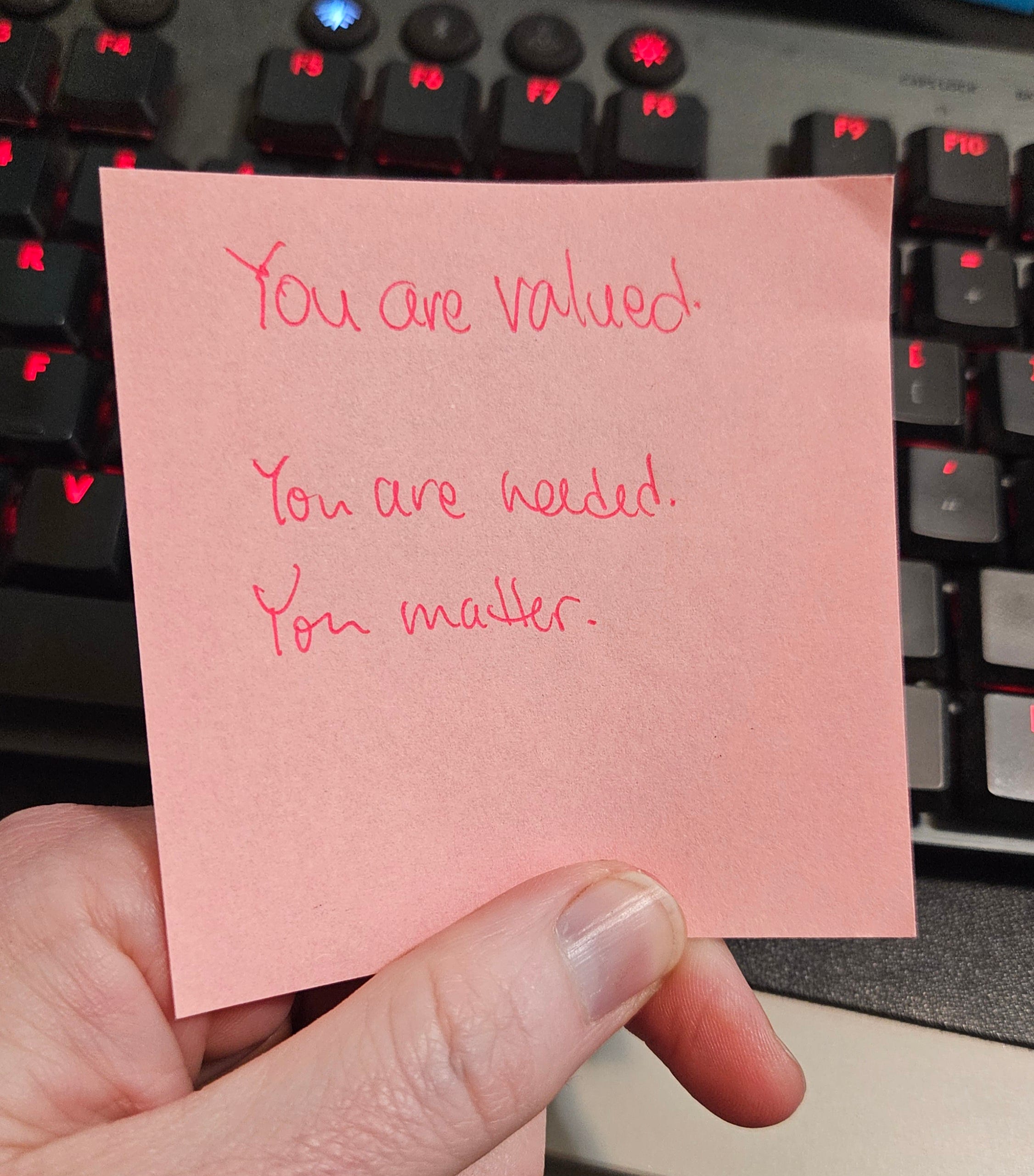
I think about my small rebellions: the handwritten note on my desk that reads You are valued. You are needed. You matter. It’s a reminder that the world around me might preach domination, but I don’t have to echo it. I can whisper back: kindness, empathy, faithfulness.
Designing better rituals of belonging starts with noticing the rituals we already live by. Do I call my neighbor by his first name because I want to break down hierarchies? Or because I’m stubborn? Do I hold space for my friend’s name change because I believe in their dignity, or because I’m trying to look progressive?
The rituals we choose shape the atmosphere we breathe. They signal whether we see others as neighbors or threats.