
Proletarian, But What Does That Even Mean?
And why the label is basically useless in today's upside-down world

How many French sociologists can you name?
If your answer is “none,” congratulations. You were me approximately ten minutes ago. And now, like someone who accidentally wandered into a museum and came out aggressively whispering things like “the use of shadow here is doing a lot,” I would like to introduce you to Pierre Bourdieu.
He is, by all accounts, a very serious person who spent the 20th century doing what serious people do: inventing concepts and giving them names that sound like they require a scarf, a cigarette, and at least one emotionally complicated relationship with espresso.
His greatest hits include:
habitus
field
forms of capital
Which sounds less like sociology and more like a yoga class taught by someone who gently judges your footwear.
Let’s start with habitus, which is your internal operating system… with vibes. It’s not a place you visit, but it does sound like a place where you’d be charged $18 for toast.
Bourdieu’s idea is that you’re doing more than making choices; you’re being made into the kind of person who makes those choices without realizing it. Your instincts, your tastes, your posture in a room, the way you hold a fork like you’re either auditioning for Downton Abbey or nervous you’re going to drop it… this is all habitus.
It’s not conscious. It’s not like you wake up and think, “Today I will embody my class position through my snack preferences. Huzzah!” No. It’s more like muscle memory for being a person.
You don’t calculate how to catch a ball; you put your hands out and catch it. Similarly, you don’t calculate whether to say “soda” or “pop” or “I’ll just have water, thanks,” in a tone that suggests moral superiority. Your body knows. Your soul knows. Your group chat definitely knows.
Habitus is the accumulation of:
your upbringing
your education
your exposure to things like museums, or Olive Garden
the subtle social cues you absorbed before you even knew you were absorbing them
It’s why some people can walk into a wine bar and say things like, “I’m getting notes of oak,” while others (me) are like, “Well, that one is obviously red.”
Now, enter the field.
A field is basically any social arena where people are competing for something: status, power, recognition, or the last soft chair at a PTA meeting.
Think:
the workplace
academia
Instagram
your neighborhood HOA (arguably the most brutal of all known fields, and I’m so glad I don’t have one, but the neighborhood GroupMe can be intense)
Each field has its own:
rules
hierarchy
weird little version of what counts as “winning”
And here’s the important part: You don’t enter a field as a neutral player. You show up with your habitus already loaded like a software package that may or may not be compatible with the system. Some people walk into a field like they were born there. Others walk in like they’ve wandered into the wrong wedding.
Bourdieu calls this your “feel for the game,” which is a polite way of saying some people instinctively know how to act, and others are Googling, “what does business casual mean,” in the parking lot.
Now we wrap this up with Bourdieu’s most quietly devastating idea:
Capital is more than money.
Money happens to be the boring, obvious form of it. He expands this into a fully fleshed-out cinematic universe of capital. Three kinds, specifically: cultural, social, and symbolic.
Cultural capital
Cultural capital is what you know, how you speak, what you like, and whether you pronounce things in a way that makes other people feel insecure. It includes:
education
taste (food, art, music, whether you say “charcuterie” correctly on the first try)
credentials
the ability to casually reference something obscure without sounding like you’re trying
And the kicker? You start acquiring this as a child, without even realizing it. It’s passed down like a family heirloom, except instead of a watch, it’s the ability to feel comfortable in spaces other people find terrifying.
Social capital
Social capital is who you know. Not in a shallow “networking event with name tags” way (although yes, that, too), but in the deep sense of:
relationships
connections
being able to text someone and skip three steps of bureaucracy
It’s the invisible ladder you didn’t build but somehow still get to climb.
Symbolic capital
Symbolic capital is prestige, reputation, honor, and the vibes of legitimacy. It’s whether or not people listen to you, not because of what you’re saying, but because of who you’re perceived to be.
It’s the difference between:
“That’s an interesting idea,” and…
“We should absolutely fund this immediately. They’re a visionary genius.”
Same sentence. Different speaker. Entirely different outcome.
The whole system (or: why life feels rigged but in a polite way)
Here’s the part where Bourdieu’s party trick is to flip the table:
His habitus, field, and capital all work together to quietly reproduce the social order. People don’t succeed because they’re talented. They succeed because:
Their habitus matches the field.
They have the right kinds of capital.
The system recognizes those things as legitimate.
Meanwhile, everyone else showed up to a chess tournament holding Uno Reverse cards. Even our tastes (what we eat, wear, listen to) aren’t neutral. They’re signals. They position us in society, which means your preference for oat milk versus whole milk is, in some deeply French way, political.
Once you learn Bourdieu, you can’t unsee it. You start noticing:
Why some rooms feel easy, and others feel like a pop quiz you didn’t study for.
Why certain conversations flow, and others feel like you’re buffering in real time.
Why someone ordering appetizers for the table with confidence feels like a power move.
And suddenly you’re more than a person. You’re a walking bundle of inherited dispositions, accumulated capital, and a habitus that occasionally betrays you when you say “pop” in the wrong zip code.
Which, according to Bourdieu, isn’t a personal failing. It’s just THE SYSTEM. This is French for you were doomed long before you got to the fancy dinner party.
An objective and extremely humble self-assessment
After careful reflection (and absolutely no bias whatsoever, other than the kind that is CORRECT), I have concluded the following about myself:
I possess very high cultural capital.
Please take a moment to appreciate your proximity to greatness. I’ll wait.
…
You’re welcome. I assume that felt meaningful to you.
Let’s break down the ingredients of this rare and prestigious condition:
Advanced communication skills (you’re reading this, aren’t you? And more impressively, you’re still here.)
Cross-domain literacy (Tech, religion, politics, and the highly specialized art of soccer sideline diplomacy, where one needs to simultaneously support children and silently judge other adults.)
Ability to translate complex systems (I can explain VPN routing and also why your neighborhood GroupMe feels passive-aggressive.)
A distinct voice (Somewhere between thoughtful reflection and “did she really say that?”)
According to people like Bourdieu, this places me in the cultural/professional elite.
Which is fantastic, except for one minor detail:
My bank account has not been informed.
Wait… so I’m still labor?
Here’s where things take a turn.
Despite all this cultural capital — this rich, inner vineyard of taste, language, and the ability to explain things at dinner parties that nobody asked about — I am still, economically speaking, in the labor class.
Cue record scratch. Freeze frame. Voicover: Yep, that’s me. You’re probably wondering how I got here.
This is where the old class-structure frameworks start to break down because if you picture the “proletariat” as soot-covered factory workers dramatically wiping their brows with a cloth while the industrial revolution hums ominously in the background like a very aggressive cello… that’s not quite what’s happening in 2026.
I mean, that’s not it AT ALL.
Instead, we have something far stranger.
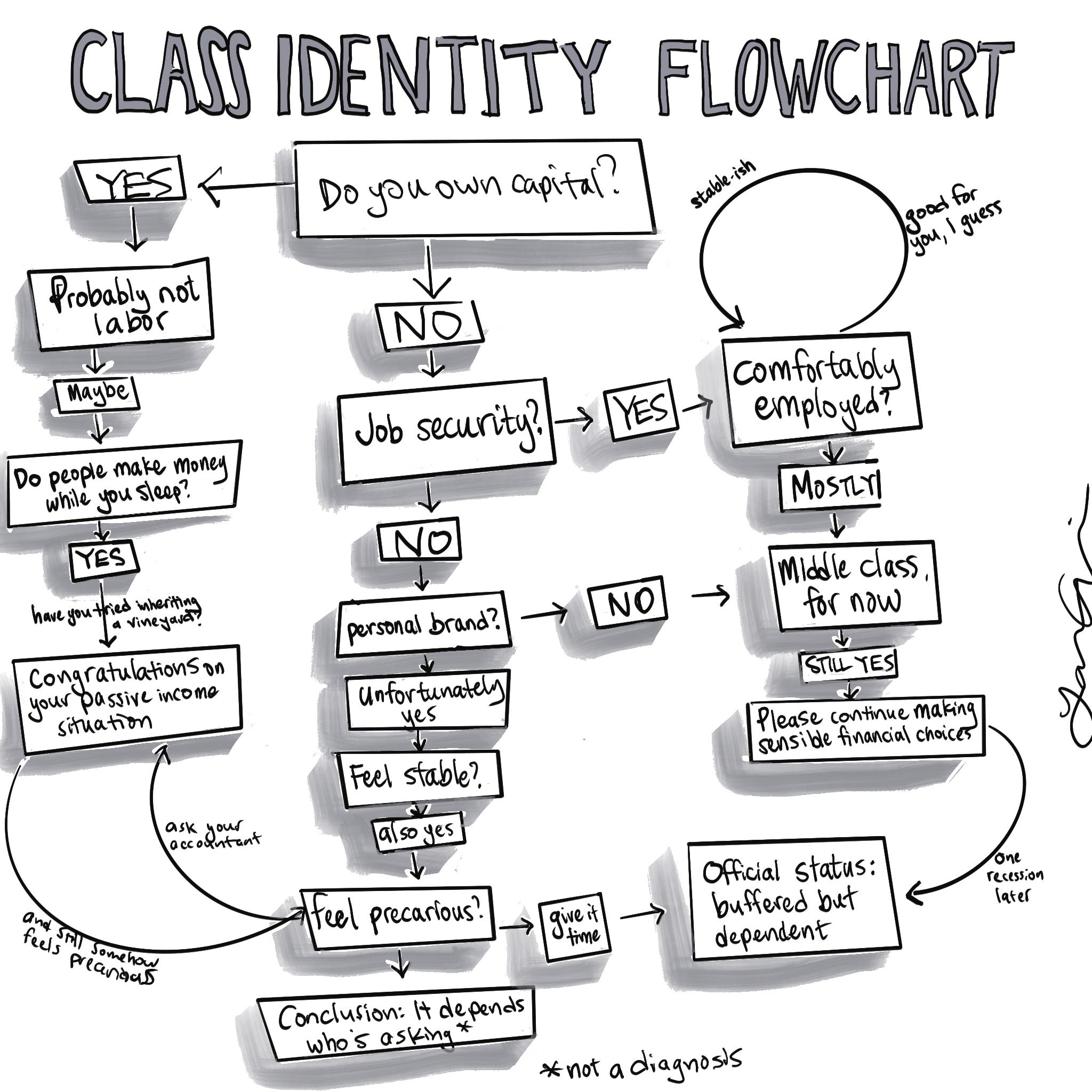
Enter: The Professional-Managerial Class (PMC)
This is the modern category many of us quietly occupy, without naming it. It’s like realizing you’ve been in the same group chat for years and no one remembers who started it.
The PMC isn’t defined by owning things. It’s defined by managing things: information, processes, systems, people’s expectations, and your own calendar. You don’t produce physical goods; you produce outputs that live in documents, dashboards, and conversations that somehow still require a follow-up meeting.
You work inside systems — companies, platforms, or institutions — that existed before you arrived and will continue to exist after you’ve lost access to your company email. You understand how they function, you can navigate them, maybe even improve them, you can rearrange workflows, refine messaging, and optimize processes, but you do not control the system.
In other words, you’re trusted to rearrange the furniture. You can pick out some throw pillows. But the deed to the house is held somewhere far above your pay grade, by people you might never meet, who occasionally send emails or #general Slack posts that start with “In light of recent strategic shifts…”
And so the PMC becomes less of a job category and more of a feeling of:
Being highly competent while also vaguely aware that the floor isn’t load bearing and could disappear at any moment, possibly during a quarterly all-hands.
And then things get weird
Because just as you’ve settled into this realization. Just as you’re adjusting to this delicate balance of competence and contingency. Another layer emerges:
The independent knowledge worker.
This is the moment when the system isn’t enough for you. You start to wonder whether you might build a smaller system of your own. You want a piece. Nothing dramatic. Just a little side project. A harmless experiment.
You start a Substack.
You buy a domain.
You open a blank page and type, “I have thoughts.” And then, almost immediately: “I regret having thoughts.”
There’s something both exhilarating and deeply unsettling about attempting to have a “voice” on the internet. It feels like stepping onto a stage you built yourself, in a theater that may or may not exist, performing for an audience that is either deeply moved, entirely imaginary, or outrageously angry that you dared to say such things.
You briefly consider becoming a THOUGHT LEADER, which is a title that feels like it should come with a warning label and possibly a rash. You imagine yourself saying something insightful and important. And then you immediately feel nauseous. Because now, in addition to doing your job, you’re also:
Curating your ideas.
Packaging your identity.
Wondering if you are, in fact, becoming a brand.
It’s like having one foot in a stable office job and the other in a canoe you built yourself, floating somewhere in the open ocean, telling yourself, “this is fine,” while quietly hoping the canoe evolves into a yacht before you run out of snacks.
From proletariat to… precariat
If Karl Marx were alive today, he would need a whiteboard. And possibly a therapist. And definitely someone to explain what a “creator economy” is without using the word “authenticity.”
Because the modern update to class isn’t as clean as workers versus owners.
It’s about stability vs instability.
Enter: the precariat.
This isn’t a class in the traditional sense, but A CONDITION. A state of being. A low-level hum of uncertainty that follows you from tab to tab as you refresh LinkedIn like it’s a vital organ.
This is the world of:
gig workers
freelancers
contract employees
overqualified people applying for jobs that require “7 years experience” in software that was released during the last year of the Biden administration
People whose job description increasingly includes something like:
“performing unpaid labor in order to maybe someday perform paid labor”
Updating résumés.
Building personal brands.
Creating content into the void.
The line between “working” and “trying to be allowed to work” has blurred to the point of abstraction.
Why you can’t tell who’s what anymore
One of the strangest features of American life right now is how difficult it is to tell who’s actually secure and who’s performing security convincingly. Part of this is because consumption has become an excellent liar.
You can have the phone, the car, the Netflix subscription, and the aesthetic. You can look, from the outside, like someone who has everything under control. Meanwhile, one unexpected expense (one medical bill, one job change, one “unforeseen circumstance”) and the entire structure wobbles.
We have, collectively, agreed to cosplay stability.
Education was supposed to clarify things. It used to be a signal. A way of sorting people into lanes that at least FELT predictable, but now, degrees have multiplied while guarantees have evaporated. A college education no longer secures a future. It merely improves your odds of being invited to compete for one.
And then culture steps in and scrambles the whole picture.
People no longer organize themselves primarily around economic position. They organize around IDENTITY: political, religious, cultural, moral. Which means two people with nearly identical financial realities can look at each other and see not a peer, but a THREAT.
The result is a social kaleidoscope where class is still there (still structuring things around), but refracted through so many layers that it becomes almost impossible to name directly.
So, where does that leave me?
Somewhere in the middle. Not precarious in the most immediate sense, but not insulated either. Capable, stable, functional… until the system that makes that stability possible decides to pivot. (Hello, AI, ahem.)
I have skills. I have a voice. I have enough stability to plan next month, maybe even next year, with a reasonable degree of confidence, but I don’t own the system I operate within. I don’t control its direction. I don’t have immunity from disruptions.
Which leads to a classification that feels both accurate and deeply unmarketable:
Buffered, but dependent.
I am like a laptop that works beautifully. It’s fast, responsive, and capable of remarkable things. As long as it remains plugged into a power source it doesn’t control. Unplug it, and suddenly all that capability comes with a countdown.
Identity: The final plot twist
Finally, we think we’ve located ourselves on the map until there’s one more disruption. Identity pushes further into the scene and politely sets the map on fire.
Because I am not ONE THING.
I am a technical professional who understands systems.
A religious participant who wrestles with meaning.
A political observer who can’t look away.
A mom navigating schedules, emotions, and the moral complexity of snacks before dinner.
A writer trying to make sense of all of it in sentences that feel true.
None of these identities align neatly into a single category. None of them map cleanly onto “class” in the way older frameworks would like them to, which means I am, in a very modern sense, unclassifiable. And the uncomfortable realization is that this is no longer unusual.
We’re all walking around like overstuffed suitcases of identity. The zippers are barely holding. The contents shift depending on the context. We’re wondering why none of the old labels fit us anymore because THE SYSTEM STILL SORTS US.
But we don’t recognize ourselves in the categories it uses.
The absurdity, summarized
If the 19th century was:
“You are a worker.”
And the 20th century was:
“You are middle class.”
The 21st century is:
“You are a highly specific combination of skills, anxieties, subscriptions, group chats, and at least one document titled ‘final_FINAL-v3-actualFINAL.doc’.”
🧠 The Ethical Technologist weighs in
Here’s the part where I put the satire down gently and pick up something sharper.
We built systems — economic, technological, cultural — that optimized for efficiency, scale, and growth. And they worked. Spectacularly.
So well, in fact, that we now have:
Unprecedented access to information.
Unprecedented tools for connection.
Unprecedented levels of confusion about who we are and where we stand.
We didn’t eliminate class. We obfuscated it. We turned it into something harder to see, harder to name, and therefore harder to challenge.
And in that ambiguity, something important becomes harder to confront:
accountability.
Because let’s be honest. We CAN identity who holds power. It’s the people with extraordinary wealth. The ones who don’t just participate in the system, but shape it.
They influence policy.
They move markets.
They set the terms that the rest of us operate within.
That part isn’t mysterious. What is harder to see and pin down is how that power is distributed through layers of systems that feel neutral and inevitable. By the time it reaches us, it’s not power. It’s bad policy, budget constraints, a platform's algorithm, or market conditions.
That’s how they rebrand it so we think not one person is responsible. No one in the room announces, “This is happening because of concentrated wealth and the incentives it creates.”
And that’s where accountability gets slippery. Not because power is invisible, but because it’s been translated into systems that make it feel impersonal, procedural, and most dangerously, unavoidable.
Then the system keeps running exactly as designed. Quietly. Efficiently. With excellent user interfaces and enough friction to make you think the problem is you.
If there’s a role for an ethical technologist in all of this, it’s not to nostalgically revive old frameworks or pretend Marx is waiting in the wings with a tidy solution and a reusable whiteboard marker.
It’s to ask better questions.
Not abstract ones. Not academic ones. Operational ones.
Who is actually secure?
Who only appears to be?
What kinds of labor are invisible, and who performs them anyway?
Where does ownership live now — in platforms, data, algorithms — and who controls it?
And perhaps most importantly:
What kind of system are we reinforcing every time we sign in, optimize, and move on?
Because this is no longer theoretical. Right now, literally this very week, there are people sitting across tables negotiating what it means to make a living in 2026. They’re not doing this in the abstract. It’s not a think piece. They sit together in fluorescent-lit rooms, with spreadsheets, budgets, trade-offs, and the very human question of what counts as enough.
My husband is one of them.
Representing a system. Sitting across from another system. Both sides trying to translate human needs into numbers that can survive a budget meeting. And what they’re negotiating is more than salary and benefits. They’re negotiating for stability in an unstable world, recognition in a system that obscures contribution, and the increasingly fragile line between “secure” and “just one disruption away.”
This is class. Not as a label. As a process.
So, no, the future of class isn’t about economics alone. It’s about systems design.
Who gets buffered.
Who absorbs shock.
Who has margin.
Who is the margin.
And right now?
Most of us are still users. Highly skilled. Deeply aware. Occasionally self-actualized, but still operating inside systems we didn’t design, can’t fully see, and are constantly being asked to optimize. (Just use AI.)
The question isn’t whether class still exists. It’s whether we’re willing to see it clearly enough to design something better.
Or whether we’ll keep refreshing the interface and calling it progress.