
"I Never Knew You"
The five virgins and the algorithm — on knowing and being known

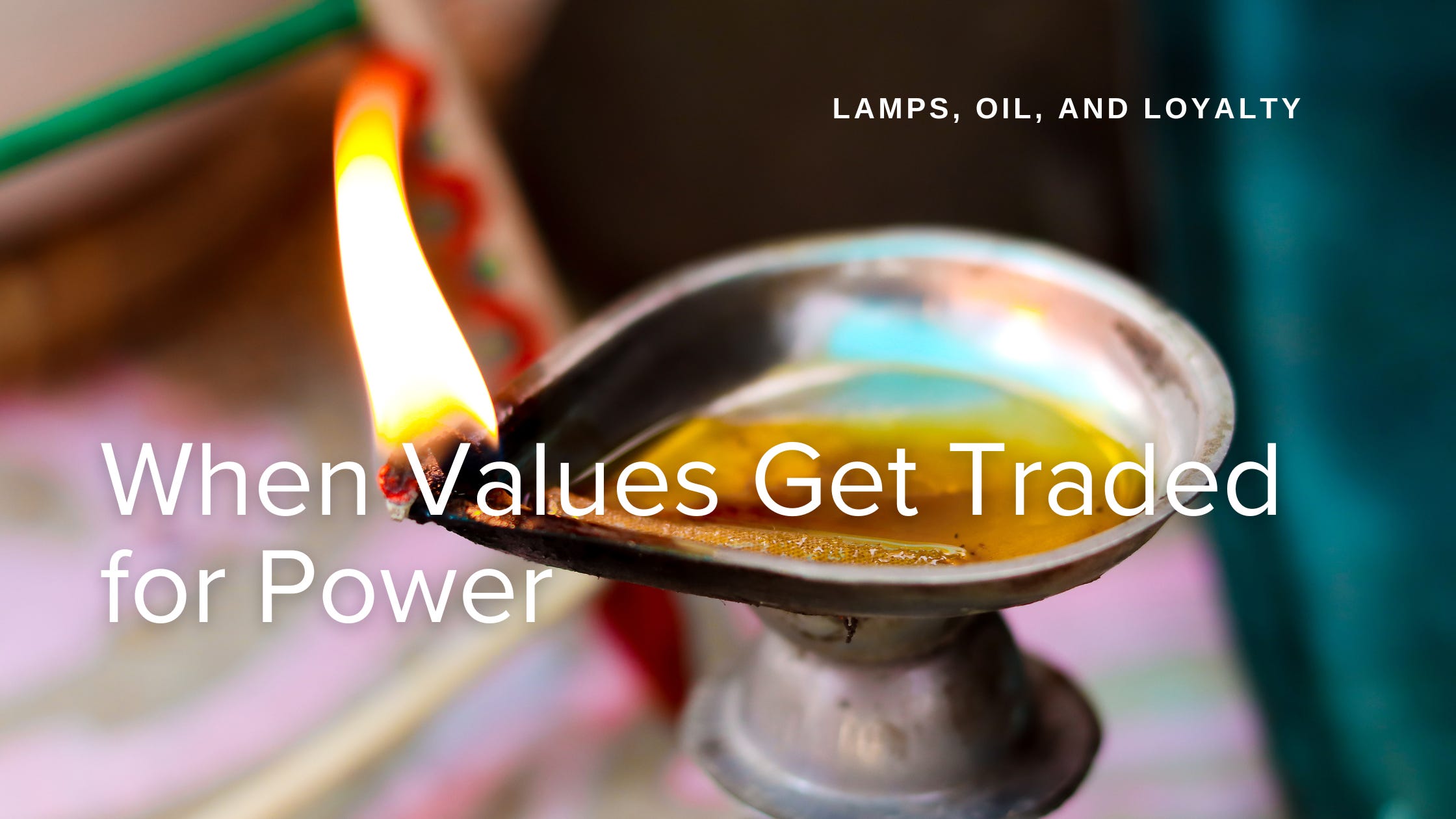
💡 Not About Oil
“…the kingdom of heaven will be like ten virgins who took their lamps and went out to meet the bridegroom. Five of them were foolish and five were wise. The foolish ones took their lamps but did not take any oil with them. The wise ones, however, took oils in jars along with their lamps.”
Matthew 25:1-4 (NIV)
After decades of Sunday School lessons, I’ve heard the parable of the ten virgins more than once. It’s usually packaged as a spiritual checklist for preparedness:
Be ready.
Stay vigilant.
Have your metaphorical lamp trimmed and burning.
But lately I’ve been wondering—did we miss the point?
Jesus didn’t say, “You ran out of oil.”
“Later the others also came. ‘Lord, Lord,’ they said, ‘open the door for us!’
But he replied, ‘Truly I tell you, I don’t know you.’”
Matthew 25:11-12 (NIV)
I never knew you.
He didn’t talk about lamps. He didn’t remark on their oil. He doesn’t mention being ready.
He speaks about relationship.
What would it take for the bridegroom to know and invite me in? Is it about the oil, or is it about whether he recognizes me, whether our values are aligned, whether we have a shared life?
About whether we’re known not by what we claim, but by the life we’ve lived.
🔄 Shifting Friendships and the Ache of Disconnection
You may have heard this saying before: people come into our lives for a reason, a season, or a lifetime. I used to think some friendships were lifetimes, but seasons change, even when I wish they wouldn’t.
“I am made and remade continually. Different people draw different words from me.”
Virginia Woolf, The Waves
Over the last few years, I’ve noticed that I’ve grown distant from more people that I used to know well. Not because we disagree. But because something deeper shifted.
I don’t recognize the values in their voices anymore.
It's like the shared compass we once used to navigate life has been replaced by a GPS that reroutes them toward fear, outrage, or whatever algorithm rewards engagement today. And when the maps no longer match, it’s hard to walk together.
This isn't about political labels.
It’s about the erosion of compassion.
It’s about watching people I care about treat cruelty as courage, spin as truth, and loyalty to ideology as a substitute for loving their neighbor.
Maybe they’d say they didn’t choose that.
Maybe they think the other side was worse.
Well, for me, the loss has been real.
🔍 The Algorithm and the Parable
Sure, you can blame me for these relationships fading away because I didn’t make an effort. It’s true. I made a choice.
Back to the parable: Now, I’m thinking about it in terms of our modern systems, especially the ones we trust too easily.
In tech, we talk a lot about inputs and outputs—optimizing for results, automating for scale, and patching bugs in the logic when things break.
Humans aren’t algorithms, though.
We aren’t optimized for efficiency or tribal loyalty. We’re made for knowing, for witnessing, for staying close when it’s hard.
That doesn’t work when moral decision-making gets outsourced to the machine, whether that machine is a party platform, a cable news cycle, or the dopamine drip of social media.
That left me choosing silence over small talk, boundaries over forced belonging. Not because I wanted less connection, but because I wanted it to mean something.
There’s not so much disagreement as a disconnection for me.
🧠 A Different Kind of Knowing

In the parable, the bridegroom didn’t say, “You didn’t believe enough.” He didn’t say, “You supported the wrong person.” He says, “I don’t know you.”
That line kind of haunts me. I can’t imagine standing at the gate outside the wedding feast, claiming proximity to divinity, while abandoning its actual ethic. “You can’t come in. I don’t know you.”
Right now, I’m realizing that the hardest part of this moment in history for me isn’t that I disagree with others. It’s that I don’t know them anymore, and some people seem proud of that.
How many relationships, like mine, have been frayed not by differing views but by a shared silence around the things that matter most: kindness, courage, and integrity?
🕯️ Maybe the Oil Was Never the Point
The parable of the ten virgins isn’t about passing a purity test. It’s not about being right. It’s about being recognizable.
If I showed up today with my flickering little lamp, would I be known?
Because maybe the oil was never the point.
Maybe the light was just a reflection of something more profound—
A life lived in integrity.
A soul that stayed grounded while others drifted.
A faith that didn’t trade away its ethics for the fleeting comfort of belonging.