
From Acedia to Easter
A Lenten journey with digital liturgies

Today is Ash Wednesday. It’s the first day of Lent, the 40-day journey leading to Easter.
Lent isn’t a formal observance in my LDS faith, but I find value in its rhythm and reflection. Ini this post, I want to explore how this season could improve my relationship to self, God, and my neighbors.
The Mirror of Erised: A Modern Reflection
In Harry Potter, Dumbledore warns Harry about the Mirror of Erised:
“Men have wasted away before it, entranced by what they have seen, or been driven mad, not knowning if what it shows is real or even possible.”
They were talking about the Mirror. But that sure sounds like my phone to me.
Dumbledore explains how the Mirror is a powerful metaphor for the danger of obsessing over unreachable desires. And that’s why I can compare it with my phone. Instead of gazing into a gilded mirror, I’m scrolling through curated feeds. Instead of longing for what the heart desires, I’m double-tapping filtered snapshots of others’ lives.
This brings me back to acedia, an old concept with a new disguise. I wrote more details about this concept in my previous substack: Acedia, Asceticism, and the Digital Age.
The early monks saw acedia as the “noonday demon,” a state of listlessness and apathy. Today, acedia is on our screens—the temptation to remain digitally distracted rather than spiritually and mentally present.
John Cassian’s Acedia, remixed for the digital age
John Cassian, a fifth-century monk, described acedia like this:
"Bodily listlessness... as though [we] were worn by a long journey or a prolonged fast... next [we glance] about and [sigh] that no one is coming to see [us]. Constantly in and out of his cell, [we look] at the sun as if it were too slow in setting."
Replace the cell with a couch and the sun with a screen, and Cassian could be describing my mornings:
Drag myself out of bed and throw on sweats.
Grab my phone and connect to the morning team call.
Walk around, phone in hand, as I wake up my kids.
Kids off to school.
Finally, I sit on the couch… still on my phone.
That’s when it hits—the pull of the scroll. I tell myself, just a few more minutes, and then a few more. I’ll share something funny. I’ll swipe through some news. I’ll linger in the digital world, where time feels malleable.
A Lenten plan for digital detox
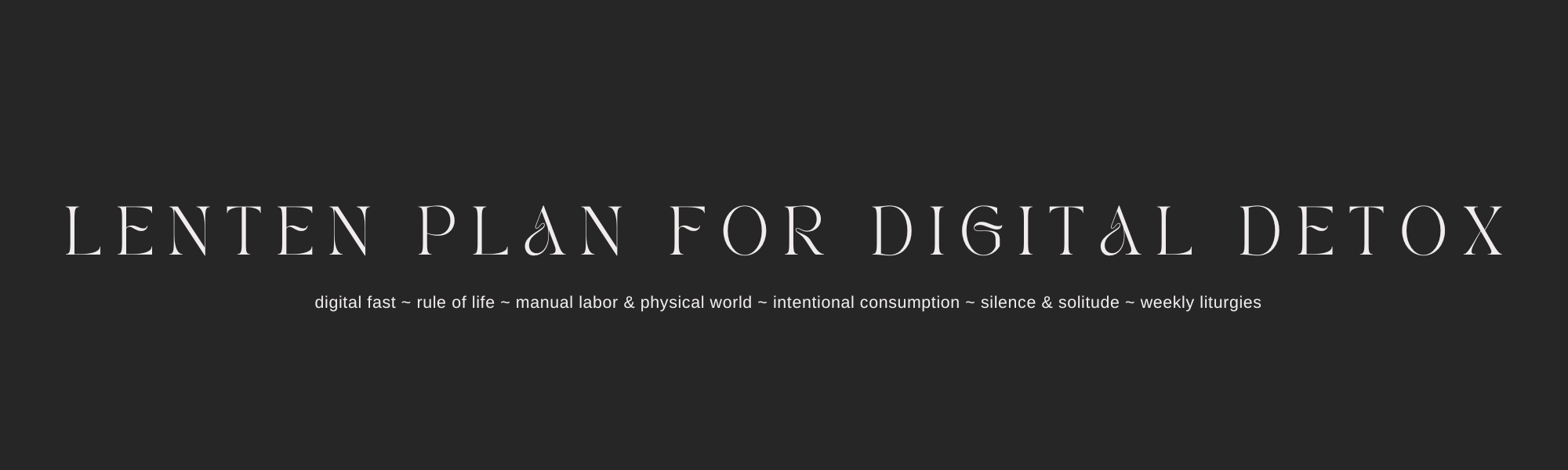
This Lent, I’m embracing the ancient practice of asceticism, not by retreating to the desert, but by creating a modern “rule of life.” I wrote this list in my previous post and am reiterating it here. These are the habits and liturgies I hope will bring me from distraction to intention:
Digital Fast: Establishing tech-free hours daily, giving my brain room to breathe.
Rule of Life: Structuring my day intentionally, creating rhythms of work, rest, and reflection.
Manual Labor & Physical World: Body combat class, weight lifting, and stretching—my specific flavors of physical exertion to counterbalance digital passivity.
Intentional Consumption: Prioritizing books over screens, with a stack of library books ready to go.
Silence & Solitude: Meditation after lunch, a reset before diving back into the grind.
Weekly Liturgies: Sunday church, Saturday hikes, and what else? I’m reading Liturgy of the Ordinary: Sacred Practices in Everyday Life and taking notes for more ideas here.
Looking toward Easter: the Atonement and redemption
As we move toward Easter, I’m also reflecting on the Atonement. Recently, I shared with my Sunday School class (I’m one of the teachers right now) about different Atonement theories, including:
Ransom to Satan
Objective Paradigm
Subjective Paradigm
Girardian Atonement Theories
These models are part of soteriology, the study of salvation. They explore why we need the Atonement, each offering a lens to understand how Christ’s sacrifice brings redemption and healing. I learned about them through an insightful article in Wayfare Magazine: Why do We Need an Atonement?
Just as the Atonement offers a path to wholeness, I hope my Lenten practices will help me find my way back to a more present, intentional life. This takes us back again to a favorite quote from Anne Lamott:
"Writing has so much to give, so much to teach, so many surprises. The thing you had to force yourself to do—the actual act of writing—turns out to be the best part. It's like discovering that while you thought you needed the tea ceremony for the caffeine, what you really needed was the tea ceremony."
For me, Lent might be the tea ceremony—a structured, sacred practice that turns out to be its own reward. A season of turning away from the digital mirror and toward something real, something eternal.