
Don't Skip the Middle
In praise of process, pattern, and the messy middle we keep trying to skip

🛫 Time zones and truths
I’m an American. I want instant results. It’s my culture.
I’ve been thinking lately about how often I want clarity, spiritual growth, even peace, without enduring the messy, meandering process that usually delivers it. The desire for shortcuts isn’t new, but it’s intensified by a modern world that sells speed as virtue.
These reflections have converged in two parts of my life right now:
Teaching a Sunday class about scripture.
Working with AI every day as a technical writer.
In the October 2022 LDS General Conference, Elder Joseph W. Sitati gave a talk on spiritual patterns. He described the disorientation of flying from Africa to the United States, resetting his body by ten hours in one day. Jet lag, as we call it, is what happens when you try to override a divine rhythm.
“Day and night is one example of patterns that God has given to everyone who has ever lived on the earth, of things as they really are.”
~Elder Sitati
We aren’t meant to skip the dark and move straight into the light. But damn if I sure don’t try!
🔄 "After the pattern"

In a religious text we’re studying at church, the phrase “after the pattern…” appears over and over again. It’s a blueprint for spiritual architecture — not of buildings, but of lives. It reframes the way we measure success. The emphasis is not on outcomes, but on imitation. On shaping our lives after the example of something enduring and divine.
This shift feels vital. Rather than idolizing perfection, can I follow the pattern of faith, humility, curiosity, and service?
Can I follow Jesus’s example in process, not just in outcome?
To do that means to shift from thinking about the Jesus who saves to thinking about the Jesus who ministers. The Jesus who walks with the crowd. The Jesus who breaks bread and sits with them. The Jesus who listens to their questions and concerns. The Jesus who squats on the ground and draws in the sand before turning to the woman next to Him.
Can I focus less on the Jesus who triumphed over death, and more on the Jesus who touched wounds and lingered with people who felt lost?
This kind of life isn’t results-driven. It’s relational. And it’s hard to measure.
And yet, modern life, especially with the rise of AI and performance culture, tempts us to outsource the struggle. We live in a world that’s obsessed with measurement. I see it daily with my work with AI. I feed it a prompt, and it spits out a polished result. It flattens process into product, removes the struggle, and redefines success as immediate output.
🧠 AI and the brain: what we bypass when we automate
AI skips the middle. I tell it what I want, and it skips the parts that teach me why I want it. The danger isn’t just in the convenience; it’s in losing my relationship with process, which is where meaning lives.
Our brains are wired for process. The right hemisphere asks, “why?” It notices beauty, lives in the moment. The left hemisphere calculates, organizes, and seeks efficiency. When we silence one in favor of the other, something within us starts to erode.
Modern life is increasingly dominated by left-brain habits: efficiency, execution, and outcome. When we remove the need to wrestle or wonder, we lose something essential.
The future is non-binary.
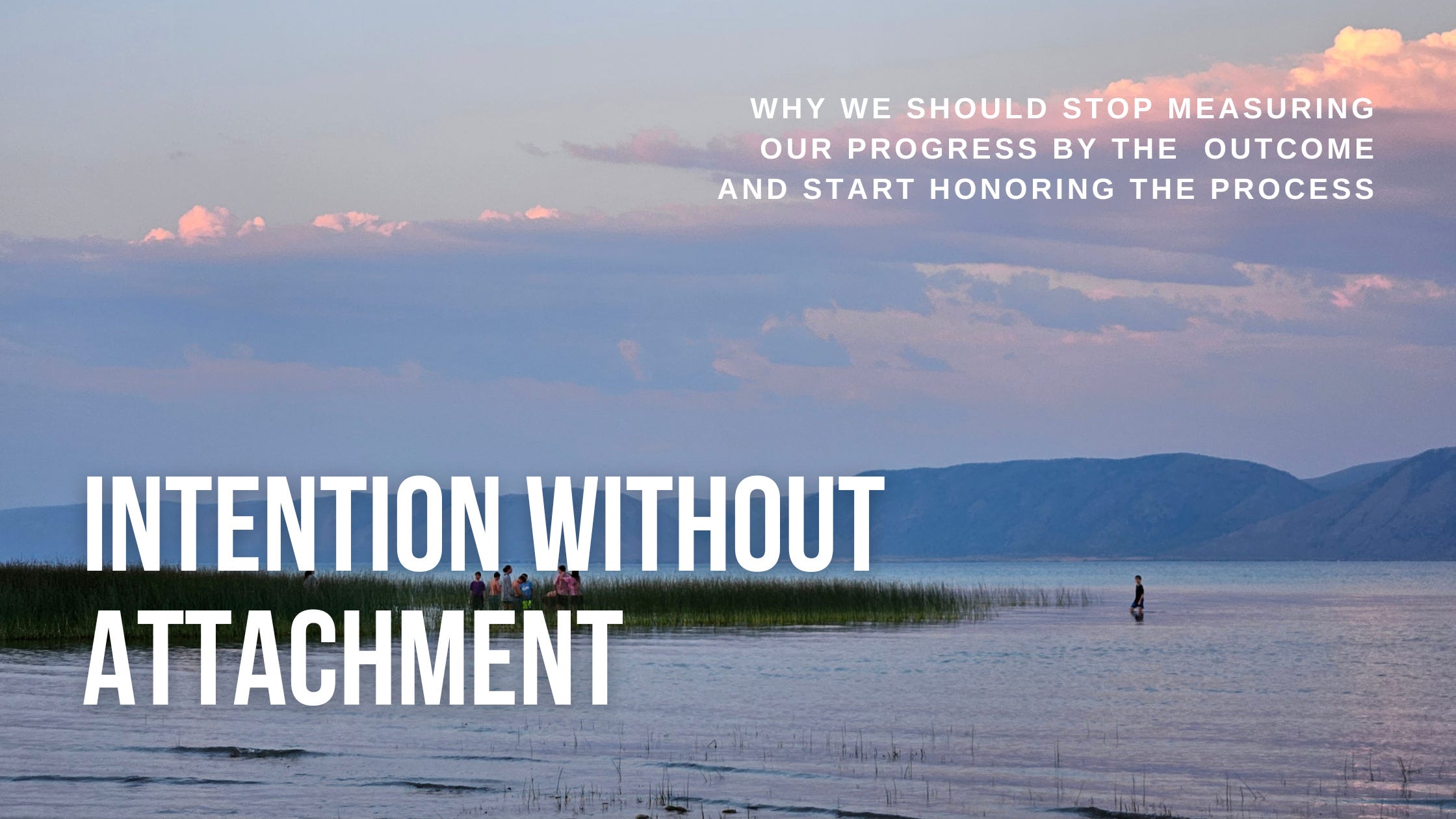
Not just in identity, but in how we think, live, and grow. Growth isn’t a binary of success or failure. It’s intention without attachment.
🌱 A Seed, a cross, and a pattern of patience
Scripture is full of people who lived this way: who acted with deep intention despite brutal circumstances.
A prophet preaches truth and is executed for it. A man teaches faith by comparing it to a seed, asking his listeners to nourish it with patience and watch it grow slowly, invisibly. Even Jesus, in Gethsemane, suffers alone while his friends fall asleep. He prays for relief that never comes and still submits to the process.
None of them say immediate results. And none of their efforts were wasted.
I’ve been through personal hardships that didn’t lead to clear-cut answers. Some issues with personal health have felt that way. And yet, I feel there’s purpose in the struggles. Because the process mattered. I followed a pattern of hope and faith, not a promise of reward. It opens me up to connection with others who are in the middle of their own struggles.
Happiness is a combination of enjoyment, satisfaction, and meaning.
~Arthur Brooks
Joy lives in the middle, not just at the end.
🔄 The Stockdale Paradox and intention without attachment
The Stockdale Paradox, named after a POW in Vietnam, Admiral Jim Stockdale, teaches us to hold two truths at once: face brutal realities and believe in eventual triumph. It’s the art of not attaching your faith to outcome but keeping faith alive through the storm.
It’s not optimism. It’s not resignation. It’s the holy tension of faith with your eyes open.
The Harvard scholar Arthur Brooks calls it “intention without attachment.” It’s a phrase that has reshaped how I think about parenting, writing, even praying. I can shop up, do the work, and not cling to outcomes I can’t control.
This is where meaning begins to form.
Coherence: understanding why things happen the way they do.
Purpose: knowing what you’re working toward.
Significance: believing that it matters.
✨ The pattern is the point
President Russell M. Nelson calls repentance “not an event… but a process.” The same could be said of growth, healing, forgiveness, and becoming. There’s no app for that. No AI shortcut.
We’ve forgotten the value of the part that’s not easily measured and that is process… the measurement is not an affirming outcome.”
~Simon Sinek
In a culture that worships productivity and prizes finality, choosing to love the process is an act of resistance. Maybe it’s even faith.
🛶 Recess, riverbeds, and remembering

Last month, I spent four days on a river trip, completely unplugged. No bars. No notifications. No multitasking.
Just water, wind, people, wildlife, and stillness. My brain took a deep breath. My heart opened. And I remembered: the reason to get up each day isn’t to win the game. it’s to feel the current. To paddle with others. To notice the rocks. To embrace recess as part of the real assignment.
Sometimes rest is the holiest act of all.
We aren’t called to bypass the journey, or even to master it. We aren’t measured by our speed. We’re called to walk the path together — step by imperfect step — after the pattern.
This really resonates with me. I want to live in a world that values the process over the results. I feel like I can see this mindset in my work at a school. Childhood is one long process that we all find joy in. And while we celebrate successes at school, so much of the day to day work is about relationships and patterns and incremental change.