
Deep Thoughts from a Nitrogen Molecule
Whom we shall call Mickey.

As I take a deep breath, it’s a big whiff of nitrogen molecules.
This is not fake news, friends. This is science.
About 78% of the air we breathe is nitrogen (N₂). Oxygen (O₂), despite all the attention it gets, is a distant second 21%. The rest is trace amounts of argon (Ar), carbon dioxide (CO₂), water vapor (H₂O), and, if you’re a Utah resident, whatever mystery seasoning is currently blowing off the Great Salt Lake bed.
So, every time I dramatically sigh while paying for groceries, I‘m mostly exhaling nitrogen.
Meet Mickey
The air you breathe today has been around.
Not necessarily as the exact same molecule. We’re not talking about one tiny molecule called Mickey that spent the Civil War touring Abraham Lincoln’s nostrils before eventually making its way through my deviated septum.
Mickey isn’t real.
But the atoms are.
The atoms making up the air in your lungs have been cycling through oceans, forests, glaciers, volcanoes, dinosaurs, and people for billions of years.
Some of the oxygen atoms I’m breathing today were forged inside stars that exploded before Earth even existed.
The hydrogen in the water vapor around me was created shortly after the Big Bang.
In other words:
I am composed almost entirely of recycled materials.
Which explains a lot.
The world’s oldest hand-me-down
The atoms in my body have had an impressive career.
At various points, they have likely been part of mountains, trees, fish, clouds, mud, and possibly a very disappointed velociraptor.
Now they’re part of me.
A middle-aged technical writer who occasionally injures herself trying to beat teenage boys to a soccer ball.
Someday they‘ll move on again.
Even my titanium toe will eventually become somebody else’s archaeological mystery.
The Mormon part
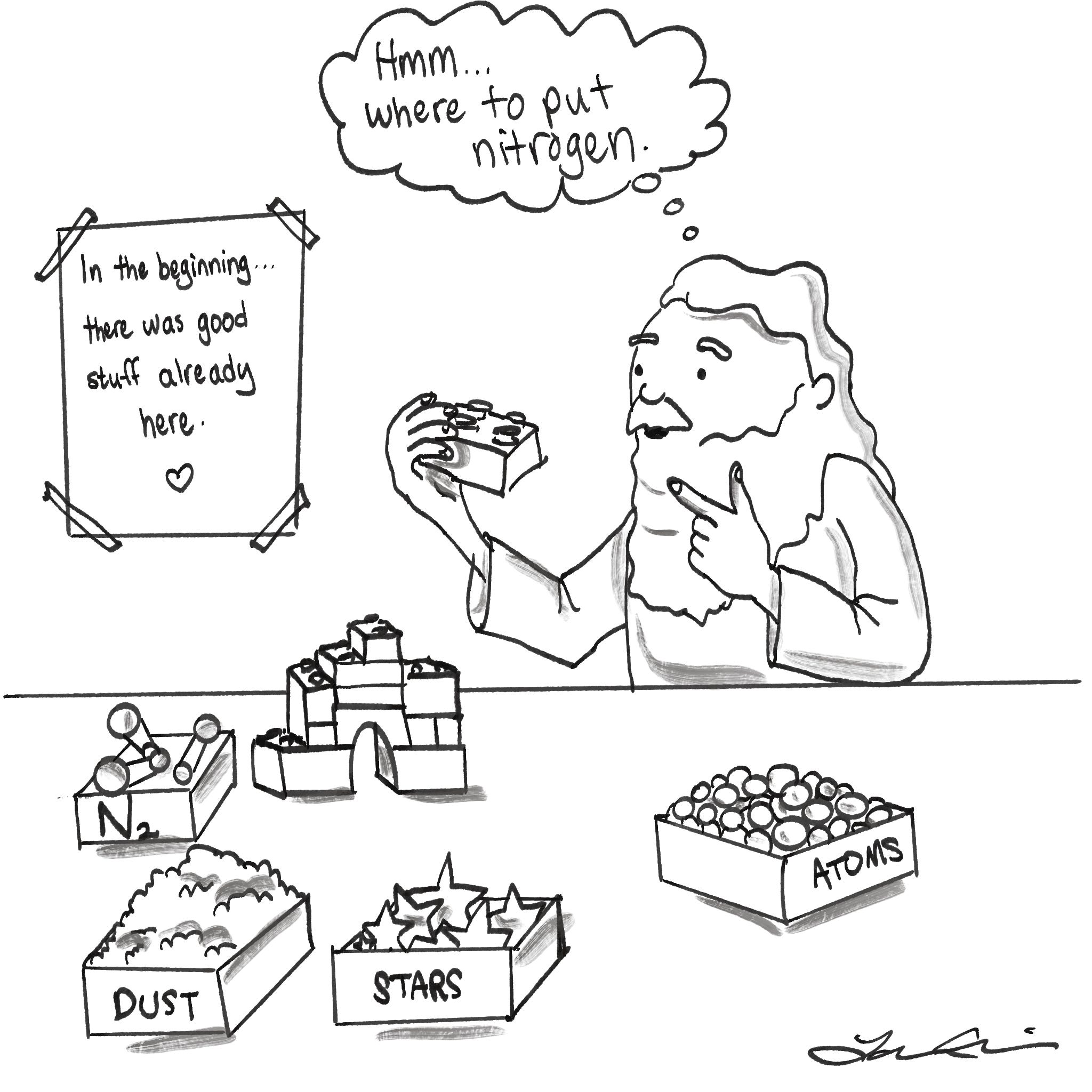
One of the things I’ve always liked about Latter-day Saint theology is that it doesn’t start with the idea that God created everything out of nothing.
Instead, the creation was about organizing existing matter.
The universe wasn’t conjured from a cosmic magician’s hat. It was ordered. Arranged. Given purpose and relationship.
Which means that, in a very literal sense, we’re made from the same stuff as everything else.
The trees.
The mountains.
The oceans.
The annoying mosquito that somehow found its way into my bedroom despite all windows being closed.
We’re all participating in the same creation.
The trees and I have a business arrangement
I love hiking. My lungs would like it known that they don’t always share this enthusiasm. But when I’m huffing and puffing up the trail, sounding like an out-of-shape accordion, I’m gifting the trees my breath. The trees take it. And they breathe back at me.
It’s one of the healthiest codependent relationships in my life.
Scientists call it symbiosis.
Ecologists call it a system.
I might call it stewardship.
Whatever term you use, the point is the same: nothing exists entirely on its own. Not forests, ecosystems, or people.
Why this matters
Y’all familiar with the scripture: “all things denote there is a God”?
As I get older and my back hurts more, I’ve become less interested in that idea as a proof and more interested in it as an observation.
The universe is full of relationships. Atoms combine into molecules, which become cells, which become living things. Living things depend on one another in ways that are obvious, invisible, beautiful, frustrating, and occasionally sticky. The pattern repeats everywhere.
Maybe that’s why so many spiritual traditions arrive at the same conclusion:
Love your neighbor, care for the vulnerable, take care of the earth, and recognize that your life is connected to other lives.
Not because we’re all one giant cosmic group project (frankly, that sounds terrible), but because none of us were meant to exist entirely alone.
The air in my lungs is borrowed. Same same for my atoms and my time here.
I don’t know about you, but I find that comforting.
Even if most of what I’m breathing is nitrogen.
I think we should start a new project: you write something, and then I comment on it completely ignoring the main point of what you wrote. (I understand the point, it's just not want I want to comment on.) Elemental nitrogen (N2) is exceedingly stable. Practically inert. The internet tells me that the average atmospheric residence time for N2 is 9.4 million years. I'll spare you the math (unless you want it) but while you are puffing up the mountain (warm day, 8000 ft elevation, don't worry, I accounted for everything) you are, with each breath, literally inhaling billions of billions of N2 molecules that have been floating around the in atmosphere since the time of the velociraptor (11 atmospheric N2 half-lives ago). (About 1x10^19 molecules per breath.)
Of the N2 in the atmosphere today, 99.999999% of it will still be in the atmosphere a year from now. It doesn't move very quickly. There is much less biological nitrogen (it's in all your proteins) and that nitrogen mostly stays in the biological pool from year to year (99.5% of it).
Pretty much everything else is much more reactive with our bodies. We use about a quart of the O2 we take in with each breath, and that reacts in our cells. The water in the air isn't really used, but does limit the amount of water we lose with each breath. But the water we eat and drink is mostly incorporated into our bodies until it works its way back out again. We are great recyclers of matter.
I'm not sure I find meaning in all of this, but I do really like math.