
College for Some, Debt for the Rest
A quiet conversation under the sun, and what the GOP’s latest bill really means for the next generation.

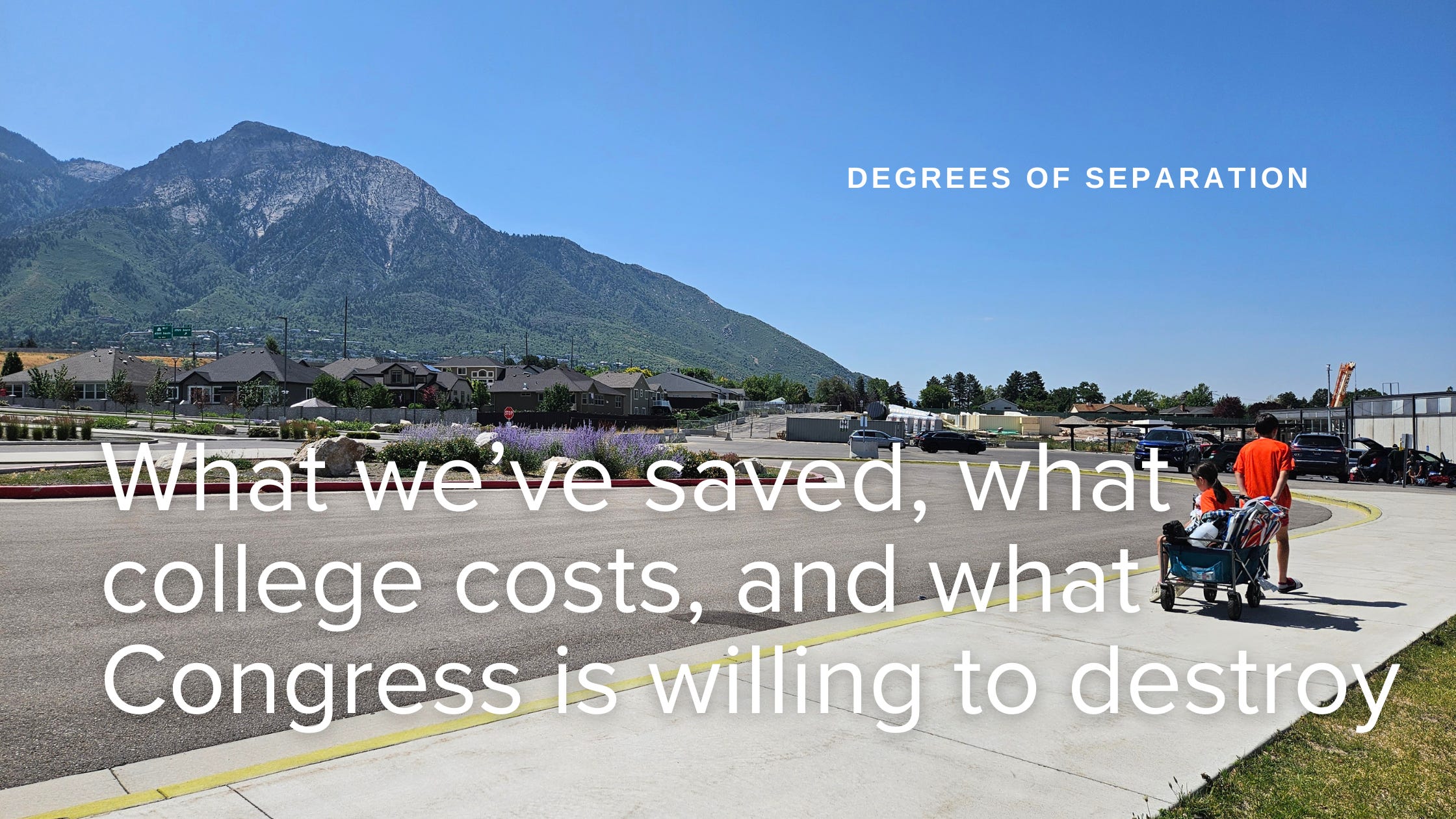
🎓Under our sportsbrella
Last weekend, we track meeted.
Yes, that’s a veb now. Because when your Saturday involves hours spent under a blazing sun, surrounded by strangers, weaving through bleacher traffic to spot which eats your kids are in, then back to the finish line like it’s a relay of your own, you get to make up verbs.
There was a lot of walking. And there was some truly impressive sprinting (not by me, let’s be clear). My kids nailed their races. It was a superb Saturday by most counts.
After the final event, we collapsed in our shade cocoon, tucked under the trusty sportsbrella. The kids wanted to finally SIT in the shade. They’d been in the hot, sweaty infield where the sun beat down with the inferno of a thousand Saudi Arabias. (I mean, I’ve never been, but I could imagine.)
In the post-race calm, conversation drifted toward the future—college, specifically.
That led to a few interesting moments:
Looking up the money saved in 529s (we’ve done well, but it ain’t enough).
Asking AI to estimate the total cost of a bachelor’s and an MBA at BYU.
Double-checking that math ourselves. (Always verify the robot.)
Doing the real calculation: What will those degrees cost by the time our kids get there?
🚨Enter the “big beautiful bill”

What I didn’t tell my kids was anything about the One Big Beautiful Bill Act (OBBBA, helluva name) that was coming in like a wrecking ball. America never got hit so hard in love. GOP wants to break some walls, but all they ever did was wreck us.
Okay, fine. I didn’t play very well off those lyrics. Apologies.
But that name? The “Big Beautiful Bill?” That’s a name straight out of a campaign rally crossed with a budget spreadsheet.
And it is truly a wrecking ball with America as its target. Not in a Mily Cyrus kind of way, but in a decades-of-prospects-smashed kind of way. Some of the proposals include (when we’re talking about college here, friends):
A 23% cut in maximum Pell Grants.
Stricter eligibility: full-time enrollment required.
The phasing out of subsidized federal student loans.
Caps on total borrowing (meaning even middle-income students can’t fill the funding gap).
🔍 Why this matters: The squeeze hits the middle

Once again, the GOP is demonstrating that it is truly the party of the people.
But only when those people are billionaires.
If you’re a working-class student, a single parent going back to school, or a family trying to help your kids chase the American Dream, well, your footing got a lot shakier.
Let’s unpack the damage:
Pell Grant Cuts: Over half of current Pell recipients lose out, especially community college students and those working while studying.
Loan eligibility restricted: Students in phased programs, parents applying for PLUS loans, and adult learners all face tighter restrictions.
Middle-income families: 520 savings were never meant to replace federal aid. Now, those accounts will come up short.
What this bill does is price people out of the future. It’s the latest chapter in a long story: America’s erosion of the middle class, turbocharged since Reagan and faithfully carried forward by a party that calls itself “populist” while dismantling opportunity.
💰 BYU example: Testing the impact
Back under the sportsbrella, when we looked up BYU tuition:
For an LDS church member, a bachelor’s at BYU will be about $27k and an MBA around $32k.
Let’s pretend that those numbers look manageable. Compared to national averages, they do.
Now let’s project that into the future: factoring tuition inflation (3%/year lately, but who knows after OBBBA), total cost of attendance exceeds $200k.
Even for families who’ve planned and saved, that’s a stretch. For others, it’s a wall.
And BYU is not like other universities for costs.
🎯 What the bill prioritizes
So where’s all this “freed up” money going? Glad you asked:
Massive tax cuts for the wealthy and corporations (adding ~$3-$5 trillion to our national debt).
Voucher/tax credits for elite K-12 schools, benefitting those already ahead.
This is a budget reallocation, not cost savings. It’s called pulling upward and squeezing downward.
🗣️ Voices Raising the Alarm
My Substack here has a small audience, but there are louder voices that are shouting about this more.
California college leaders are warning that Pell cuts would “cripple economic and social mobility” for 700k low-income students.
No American dream for you.
The AAU student advocacy cautions that the bill is devastating for access to higher education.
And voices from Inside Higher Ed described the bill an “implementation nightmare,” citing administrative chaos and a mass disenfranchisement of students.
This isn’t policy. It’s sabotage.
📚 Broader implications
Higher education does more than open career doors. It’s correlated with better health outcomes, stronger civic engagement, higher volunteerism, and lower incarceration rates.
It helps create the informed citizenry we claim to value.
But here’s the irony: we’re accelerating into an era of automation, AI, and global complexity, while slashing support for the very people who will have to navigate it.
We don’t prepare students for the future by cutting their parachutes.
📝 Ethical technologist notes
A society that guts access to education isn’t serious about innovation. Or opportunity. Or democracy.
In my work as a technical writer in cybersecurity, I document (quietly, behind the scenes) our tools that secure digital ecosystems. My audience is global. On our team calls, I chat with colleagues in Canada, Ukraine, Colombia, and California. We exchange feedback on documentation, share bug reports, and yes, trade memes about the Russian invasion. Humor still matters. So does perspective.
But I don’t write political manifestos in my day job. I write instructions—how to configure, secure, and deploy. It’s not partisan. It’s about clarity, efficiency, and trust.
That’s why this post isn’t about red versus blue. It’s about the breaking of a social contract. A society that guts access to education isn’t serious about innovation. Or opportunity. Or democracy.
When I sat under that umbrella, running college costs with my kids, I saw the disconnect.
This isn’t about numbers. It’s about their future.
It’s about whether we believe that building a better world means investing in people, not just platforms. A truly ethical technologist doesn’t just ship code. They ask: Who is this for? Who’s left out? What world are we building?
And if that world is one where college becomes a luxury, while tax cuts masquerade as freedom, we owe it to the next generation to say: not on our watch.